


Mandala as Healing and Connection: The Art of Johannes Frischknecht
Gabriel Lee
30 Jul 2025
As one stares at the colourful patterns, one sees a chaotic order, a unique manifestation of primal creativity. The Swiss painter, Johannes Frischknecht, blends spiritual insights with profound cultural contemplation together in his mandala paintings, whose bold disposition shows a deep engagement with Tantric Buddhism and artistic innovation.
Frischknecht’s fascination with mandalas began at an extraordinarily young age. Mandalas, derived from the Sanskrit word for “circle,” are geometric designs that represent the cosmos, wholeness, and the interconnectedness of life in various spiritual traditions, particularly in Hinduism and Buddhism. For Frischknecht, this early encounter was not merely a creative exercise but the beginning of a lifelong journey that would intertwine art with spiritual exploration.
His formal education and self-directed studies further shaped his path. Frischknecht attended art schools in Zurich and Basel, where he honed his technical skills. However, his immersion in Tibetan culture and philosophy proved equally formative. From 1972 onwards, he studied at the Tibet Institute in Rikon. This experience deepened his understanding of Tibetan Buddhism, its rituals and traditions, particularly the creation of mandalas as tools for meditation and spiritual transformation. By learning the Tibetan language and working as an interpreter for lamas, Frischknecht gained unique insights into the cultural and philosophical underpinnings of mandala art, which would become the cornerstone of his paintings.
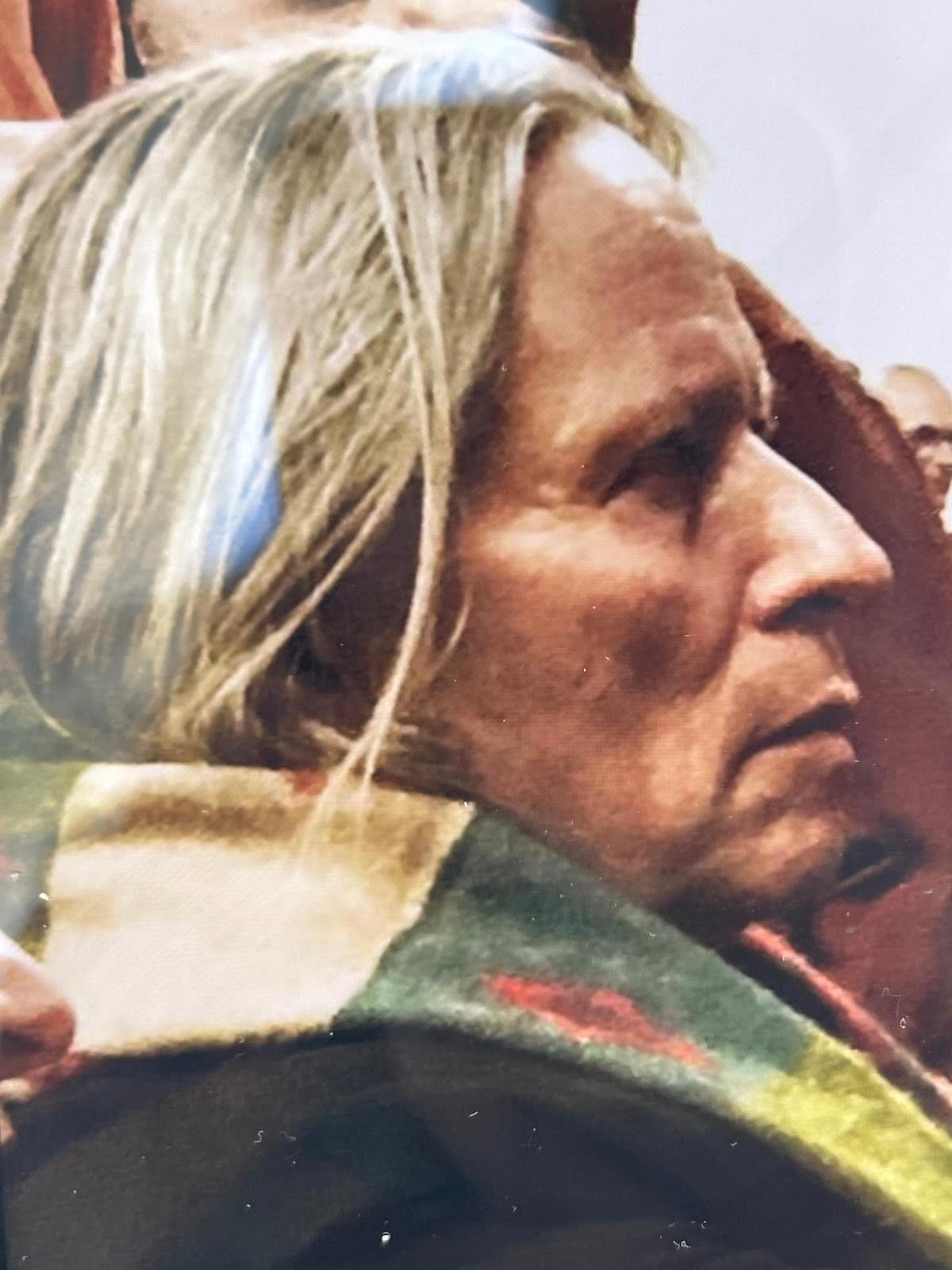
Johannes Frischknecht
Frischknecht’s mandalas are characterized by their intricate designs, vibrant colors, and meticulous attention to detail. Often created with colored pencils, his works exude energy and precision. His pieces are not merely aesthetic; they are imbued with symbolic meaning, drawing from the rich iconography of Tibetan Buddhism. Each mandala serves as a visual representation of his unique perception of spirituality, guiding viewers toward contemplation and inner peace.
Frischknecht’s artistic process is deeply meditative. He approaches each mandala as a spiritual practice, channelling his understanding of Buddhist philosophy into his creations. His work reflects the principle of impermanence, not through destruction but through the acknowledgement of life’s transience. He explores the interplay between the external world and inner consciousness, encouraging viewers to reflect on the illusory nature of the ego and the interconnectedness of all things.
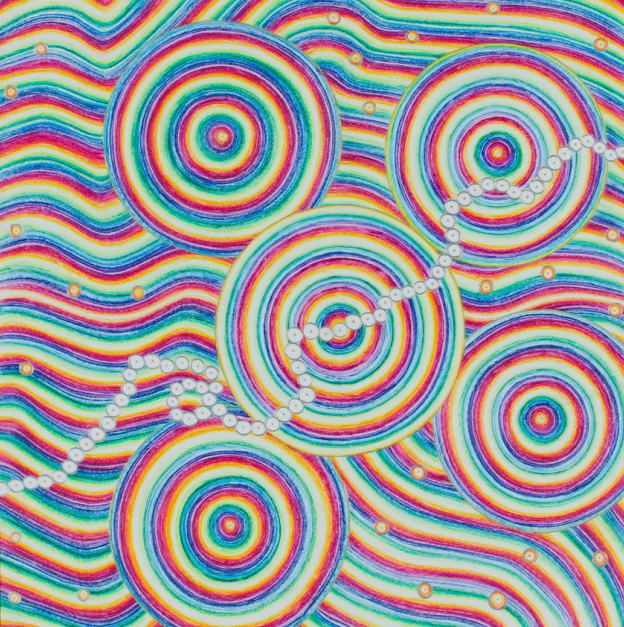
Johannes FRISCHKNECHT
2023
oT
color pencil and acrylic on cardboard
100 x 100 cm
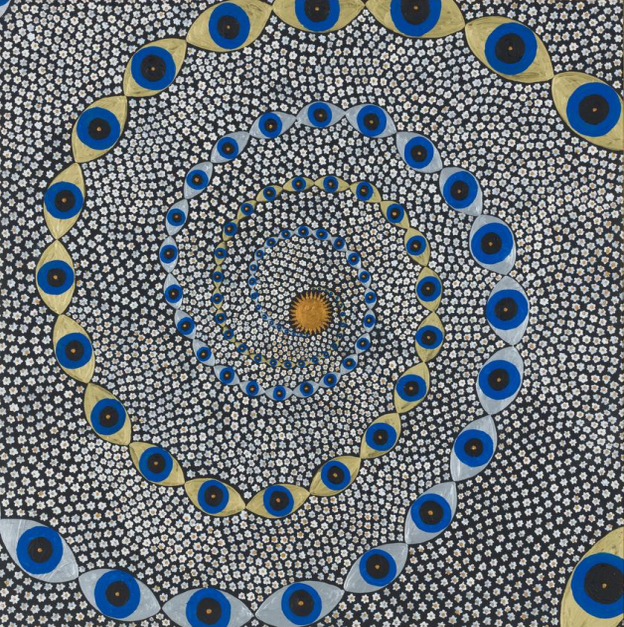
Johannes FRISCHKNECHT
2023
oT
color pencil and acrylic on cardboard
100 x 100 cm
At the heart of Frischknecht’s mandala work lies a profound connection to Tibetan Buddhist philosophy. Since 1972, he has studied under many Tibetan lamas, representing all four major Buddhist schools. This extensive engagement has allowed him to integrate authentic spiritual principles into his art. His relationship with Gangteng Tulku, his primary lama since 1987, further deepened his understanding of Buddhist rituals and meditation practices, which he channels into his mandala creations.
Frischknecht’s mandalas are more than artistic expressions; they are tools for healing and self-discovery. He describes them as “Mandala Heilkunst” (mandala healing art), emphasizing their therapeutic potential. In his workshops, Frischknecht introduced participants to the philosophical and practical aspects of mandala creation. These courses not only teach artistic techniques but also guide students in using mandalas as a means of introspection and spiritual growth. By engaging with the symmetrical patterns and symbolic elements, participants are encouraged to explore their inner worlds, confronting fears, hopes, and doubts in a process akin to meditation.
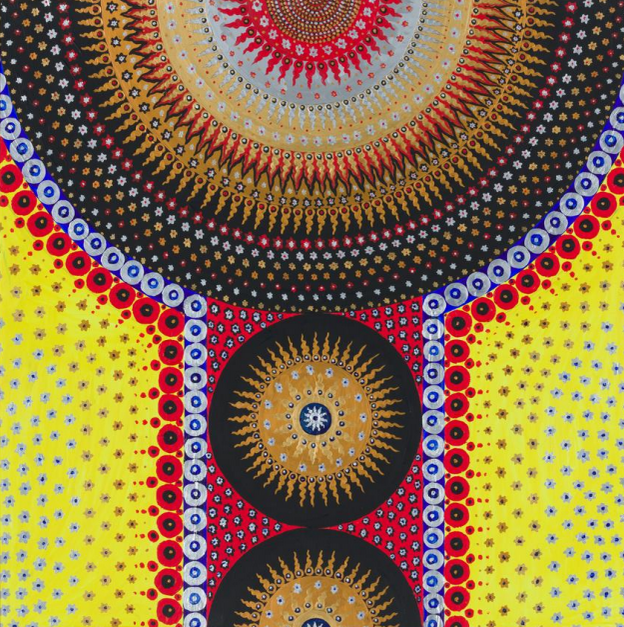
Johannes FRISCHKNECHT
2023
oT
color pencil and acrylic on cardboard
100 x 100 cm
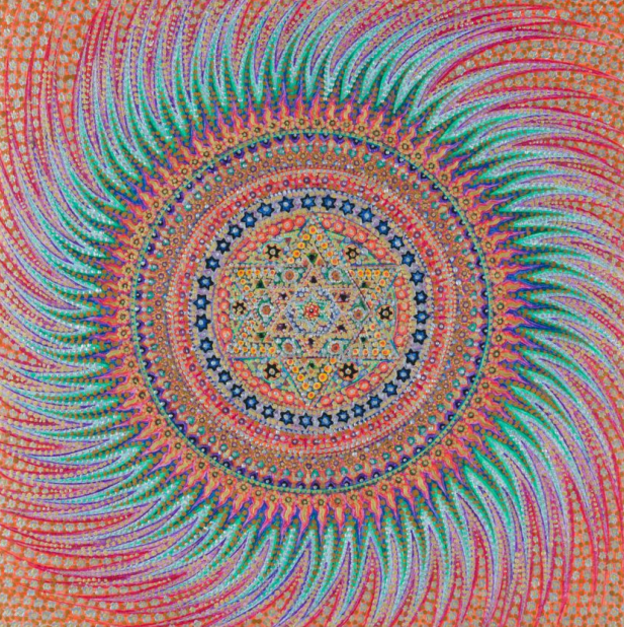
Johannes FRISCHKNECHT
2023
oT
color pencil and acrylic on cardboard
70 x 70 cm
His writings, such as the piece on the “Path Outward” mandala, reveal the philosophical depth of his work. Frischknecht reflects on the human tendency to focus on the external world, only to realize its impermanence. Through mandalas, he encourages a shift inward, where individuals can confront the illusory nature of the ego and cultivate a sense of unity with the universe. This aligns with the Buddhist concept of emptiness, which posits that all phenomena lack inherent existence and are interdependent.
Cultural Synthesis and Global Impact
Frischknecht’s work extends beyond the canvas, embodying a unique synthesis of Eastern and Western cultural elements. His studies in Paris, where he earned a diploma in cultural management in 1988, equipped him with the skills to bridge these worlds. As an “Ingenieur Culturel,” he has organized exhibitions, seminars, and pilgrimages to sacred sites in Tibet, Bhutan, and India, fostering cross-cultural dialogue.
His role as a practitioner of Tibetan Buddhism, which began at age 16, underscores his commitment to cultural preservation. By translating for lamas and organizing events like the 1985 Kalachakra peace ceremony in Rikon, Frischknecht has played a significant role in introducing Tibetan spiritual practices to European audiences. His mandala art serves as a bridge, making esoteric concepts accessible through visually captivating designs. His mandala art cards, books, and calendars have reached a wide audience, with over 100 of his designs available as prints. These accessible formats have democratized mandala art, allowing individuals to incorporate it into their daily lives. His cultural centre in Senegal, initiated in 1994, further demonstrates his global vision, extending his mission of cultural and spiritual enrichment to new regions.
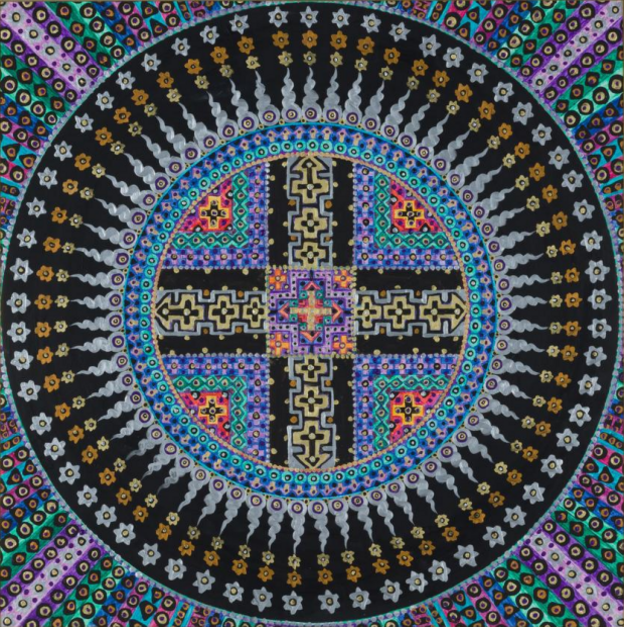
Johannes FRISCHKNECHT
2024
oT
color pencil and acrylic on cardboard
70 x 70 cm
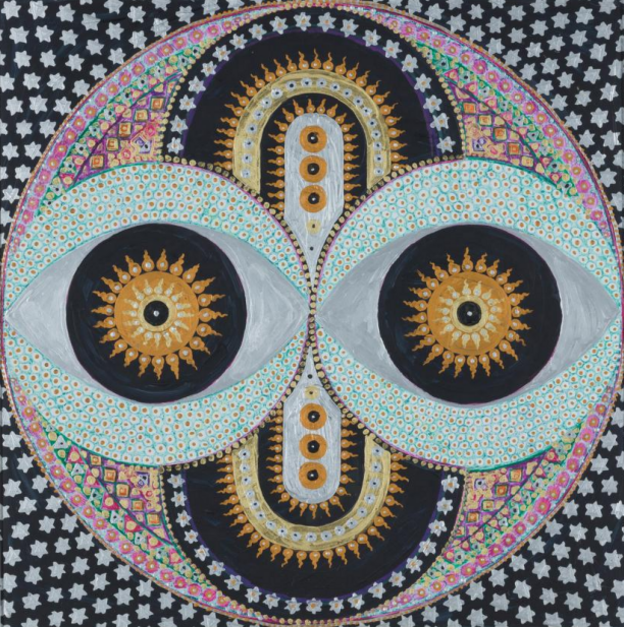
Johannes FRISCHKNECHT
2019 – 2020
oT
color pencil and acrylic on cardboard
50 x 50 cm
Johannes Frischknecht’s mandala work is a testament to the power of art as a vehicle for spiritual and cultural exploration. His ability to blend technical skills with profound philosophical insight has earned him recognition across Europe and beyond. By making mandalas accessible through exhibitions, workshops, and publications, he has transformed an ancient practice into a contemporary tool for personal and collective growth.
His gallery remains a hub for those seeking to experience his work firsthand. Frischknecht’s commitment to teaching, whether through art workshops or Buddhist seminars, reflects his belief in the transformative potential of mandalas. His multifaceted career—as an artist, teacher, translator, and cultural ambassador—embodies the mandala’s essence: a harmonious integration of diverse elements into a cohesive whole.
In a world often marked by division and distraction, Frischknecht’s mandalas offer a path to unity and reflection. They remind us of the impermanence of material existence and the enduring power of inner exploration. As he continues to create the mystical mandala on canvas, Johannes Frischknecht’s work remains a vibrant testament to the enduring relevance of art and spirituality in fostering a solid connection and comprehensive understanding between the East and the West.
Gabriel Lee
Independent writer
On art, culture, and dance