




Art, Technology, and Community: Entering the Silicon Era with CryptoZR
Guoying Stacy Zhang
25 August 2025
CryptoZR is among the rare visionaries working at the intersection of art and blockchain. Her practice spans multiple media and reflects a profound understanding of blockchain technology, cryptography, and conceptual art. Deeply interactive, her works invite participation and emotional engagement, often revealing layers of meaning that resonate most fully with crypto natives, while also illuminating the field for those just beginning to explore it.
A leading figure in the crypto art movement, CryptoZR’s works are held in prominent institutional and private collections. Before establishing herself as an artist and entrepreneur, she served as Chief Product Designer for Global SNS at Tencent’s International Business Department. She has since founded multiple digital art marketplaces and crypto projects, experiences that now inform an artistic practice distinguished by conceptual depth, meticulous execution, and an unwavering commitment to innovation.
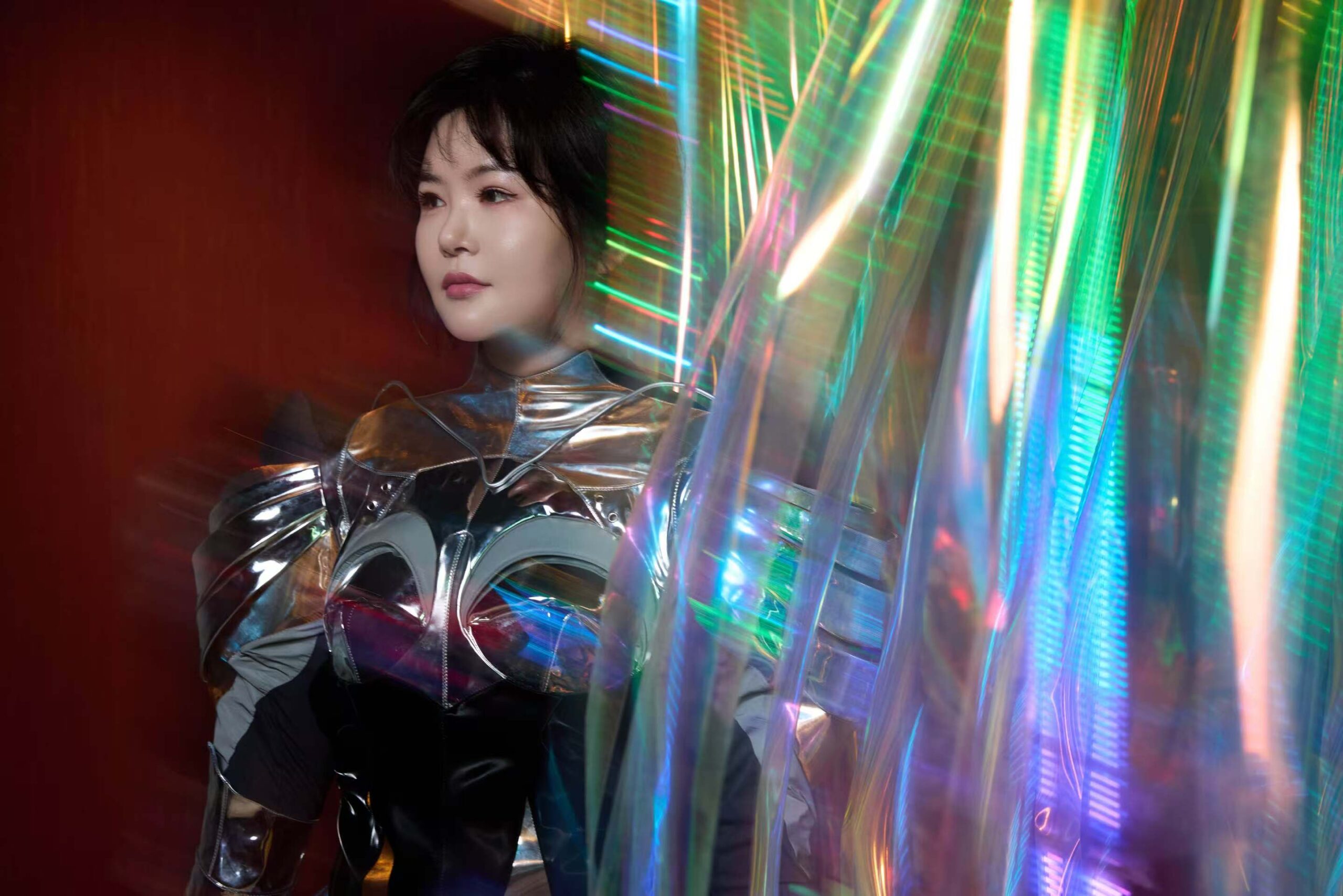
CrytoZR (Liu Jiaying). Image courtesy of the Artist
When Dennis Koch, who leads the art program at Bitcoin Magazine, invited me to co-curate Bitcoin Asia 2025 in Hong Kong, CryptoZR was the first artist who came to mind. Based in the city, her presence bridges crypto hubs in the United States and China, reflecting the cross-cultural dialogue that is essential to the future of this field.
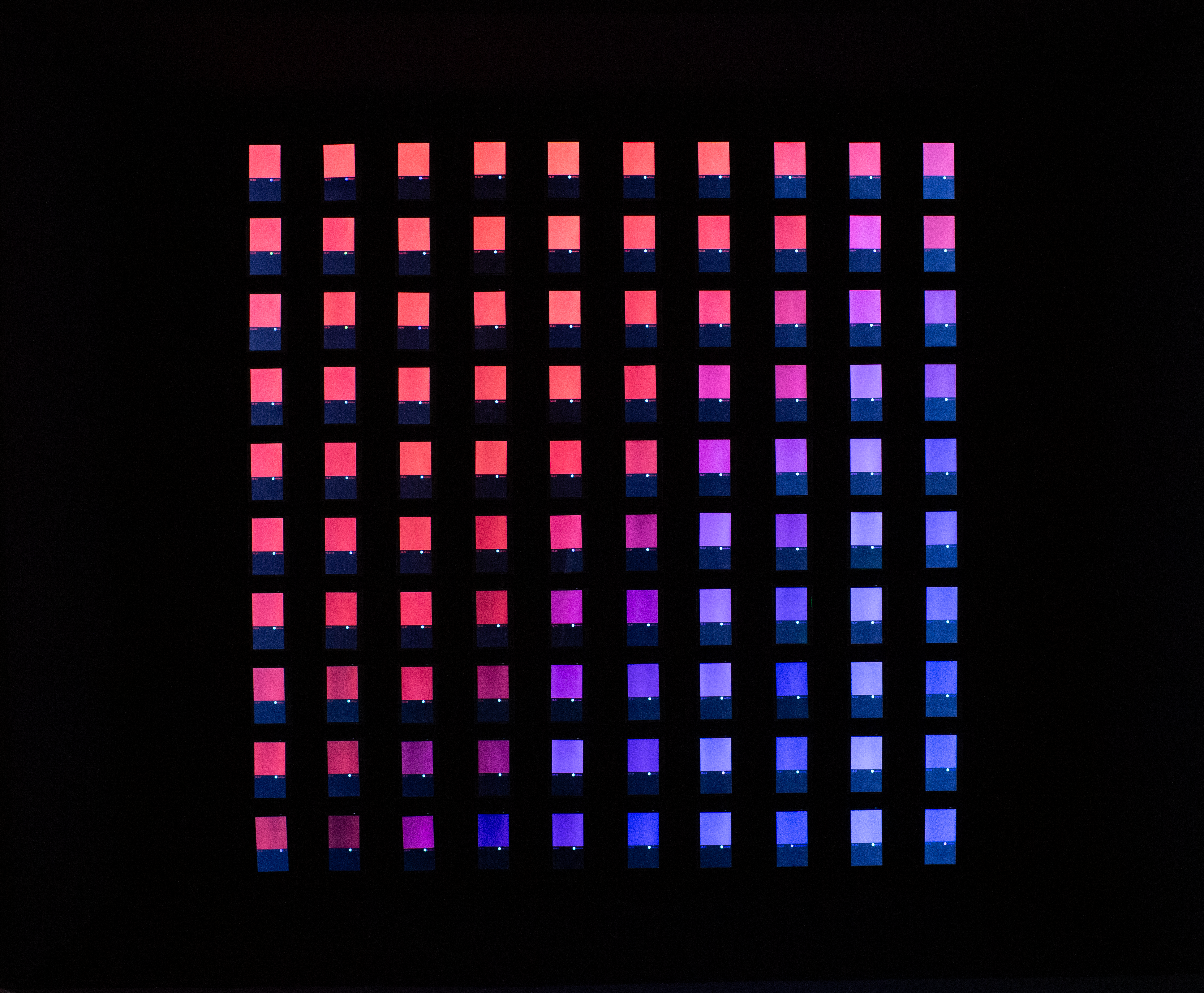
Red and Blue, 2019, an NFT-based project inspired by the 2018 China-US trade war. Image courtesy of the artist
Ahead of the conference, we sat down for a conversation. What follows are some insights into her thinking and practice. For a deeper look at her work, I encourage you to explore her website: https://cryptozr.net/.
Zhang: What are your views on the convergence of art and technology?
CryptoZR: For me, technology is a new language, a medium, and a carrier of meaning — but also a tool to extend imagination. Blockchain, for instance, is one such tool.
Humanity is at a watershed moment: there are humans with writing and humans without it; humans with the internet and humans without it; and now, humans with crypto/AI and humans without. These are fundamentally different worlds.
Our contemporary society has been completely reshaped by data, algorithms, crypto, and artificial intelligence. This shift doesn’t only transform the economic system — it also redefines how we understand the world and communicate with one another. Cryptocurrencies and the cryptographic foundations behind them enable people across geographies, races, and cultures to achieve consensus through technology, evolving new forms of social contracts and ideologies.
What the audience sees is not merely technology itself, but how humanity and civilization are being reshaped within these new networked structures. Art, in this context, becomes a means to document the birth of a new culture in the silicon-based era.
Zhang: How did you find CryptoArt? What are your inspirations in your practice?
CryptoZR: I entered the crypto industry in 2017, founding several crypto projects that successfully launched on exchanges like Binance, Coinbase, and OKX. In my early work, I noticed how flexible and open-ended smart contracts were when implementing ERC-20 tokens. That sparked my exploration of the potential intersections between cryptocurrency and art.
My first experimental work “Out of Nothing”, posed a simple question: What would happen if, upon adding a specific token to one’s Ethereum wallet, the initial balance was not 0 but 88,888? The result was unexpected — over 580,000 wallets added the token and began trading it on the decentralized exchange EtherDelta, and to this day, some addresses continue trading it via Uniswap.
This work led me to a critical realization: Where does the value of money come from? If value is derived from consensus, then securing attention becomes a prerequisite for building consensus. Attention is currency. The later memecoin craze only confirmed that many players in the ecosystem have since internalized this mechanism.
This example reflects my creative approach: I use blockchain technology as an artistic medium — whether through smart contracts, public chain modifications, Bitcoin inscriptions, protocols, NFTs, metaverse, DeFi, or on-chain data. Every emerging blockchain technology provides new material for my work, and when combined with the culture of the crypto community, they collectively shape my creative inspiration.
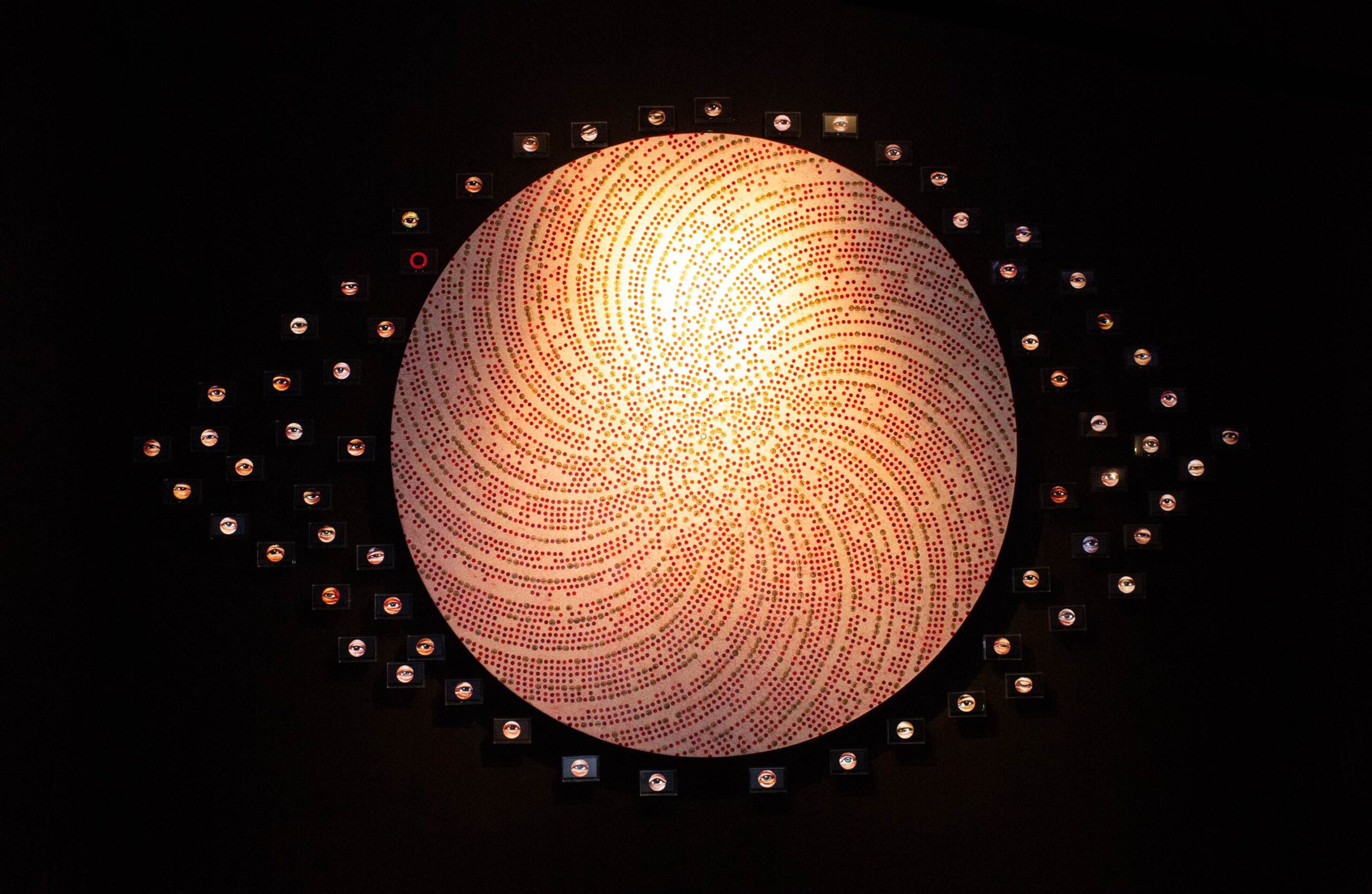
1000EYE, 2021, presenting the eyes of Satoshi Nakamoto at the center and displaying the eyes of 1000 most representative figures in the 21st century. Image courtesy of the artist
Zhang: Tell us something about your work to be showcased at Bitcoin Asia.
CryptoZR: “The Consensus” is a conceptual, mixed-media artwork I created in 2024. It consists of 410 historical statements and commentaries about Bitcoin, collected from voices across finance, technology, academia, and even the crypto community. The same dataset manifests in three distinct forms, depending on its medium of presentation:
- 1. On the project’s website, the information appears in the visual style of The Times newspaper.
- 2. On-chain, the full texts are permanently stored as Bitcoin inscriptions.
- 3. At the exhibition, the texts are engraved on wooden panels as a physical manifestation.
Each media fragment includes the author’s name, position, date, BTC price, and a QR code linking to the original article. These statements are arranged chronologically from left to right, turning each into a timestamp. The audiences can revisit the original context of the commentary and compare the article’s perspective with their own understanding of Bitcoin at that historical moment.
From Bitcoin’s first $0.0025 pizza transaction to a price increase of 40 million times in under sixteen years, the journey of consensus-building has been extraordinary. Along the way, Bitcoin has been declared “dead” thousands of times. But why do people resist new paradigms so intensely? What psychological motivations drive these declarations? If people could return to those moments, would they evaluate them more objectively? More importantly, over fifteen years of uncertainty, do people have the courage to overturn their past conclusions? And do they possess the conviction to uphold their beliefs amid an unpredictable future?
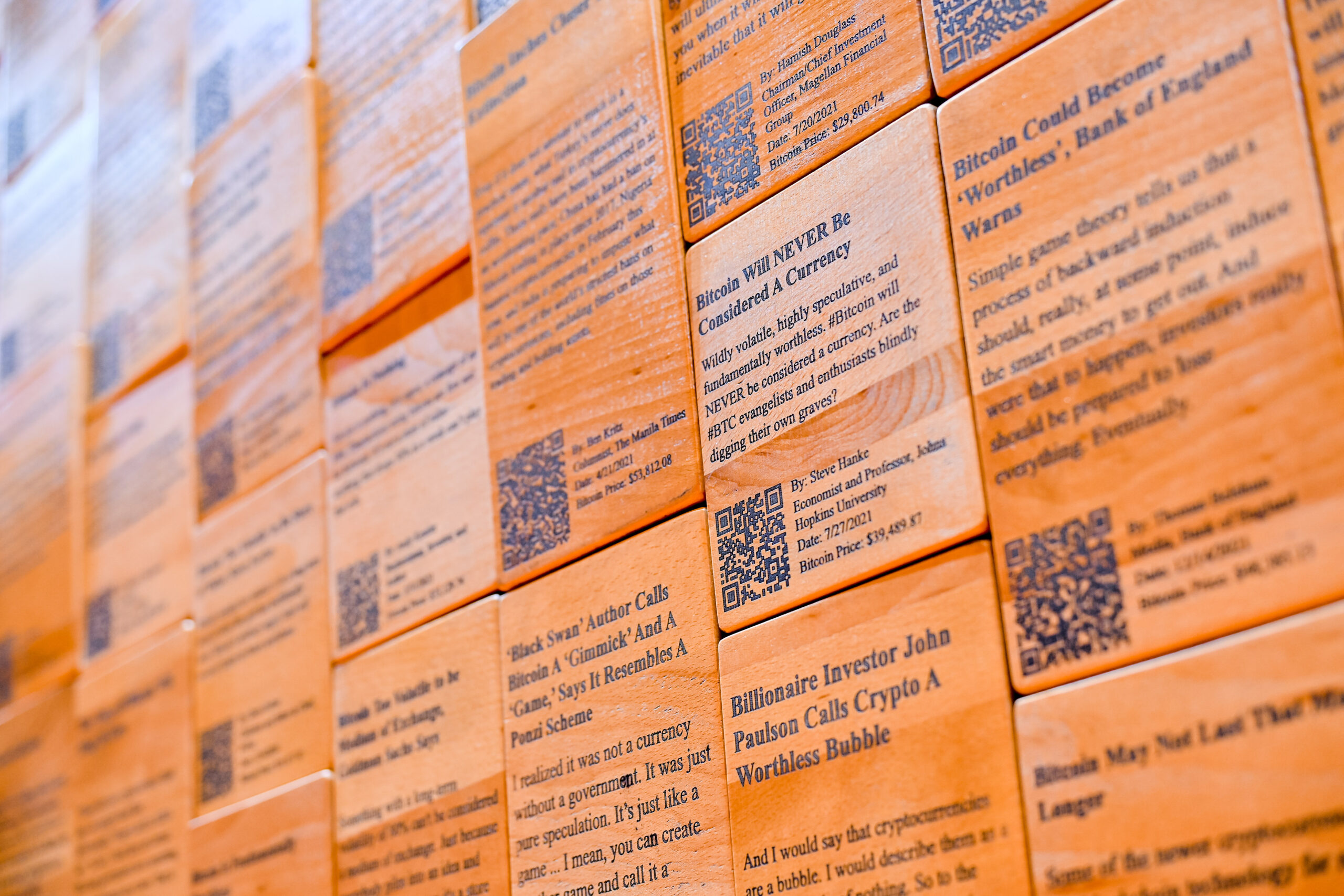
The Consensus (detail), 2025. Image courtesy of Bitcoin Asia
At Bitcoin Asia 2025, the physical installation comprises 410 engraved wooden panels mounted over an oil painting backdrop. As visitors purchase panels, staff will remove them live and hand them over. Gradually, as the panels disappear, the oil painting beneath emerges, revealing a new consensus: “We Are All Satoshi.” The act of buying a panel alters the trajectory of the artwork’s consensus — a collective statement about how change happens. Perhaps true consensus doesn’t come from the voices of established opinion leaders, but from individuals who take action.
Just as global consensus on Bitcoin evolved, new consensus continuously replaces the old — across art, technology, and beyond. Within crypto art itself, NFTs have not yet been fully absorbed into traditional art-historical discourse. But true crypto art extends far beyond NFTs, encompassing diverse formats and even novel asset forms. While the technical barrier can make this domain challenging to decode, I believe the next generation of art scholars — growing up in a cryptographic era — will overcome these hurdles and establish rigorous frameworks for evaluating crypto art.
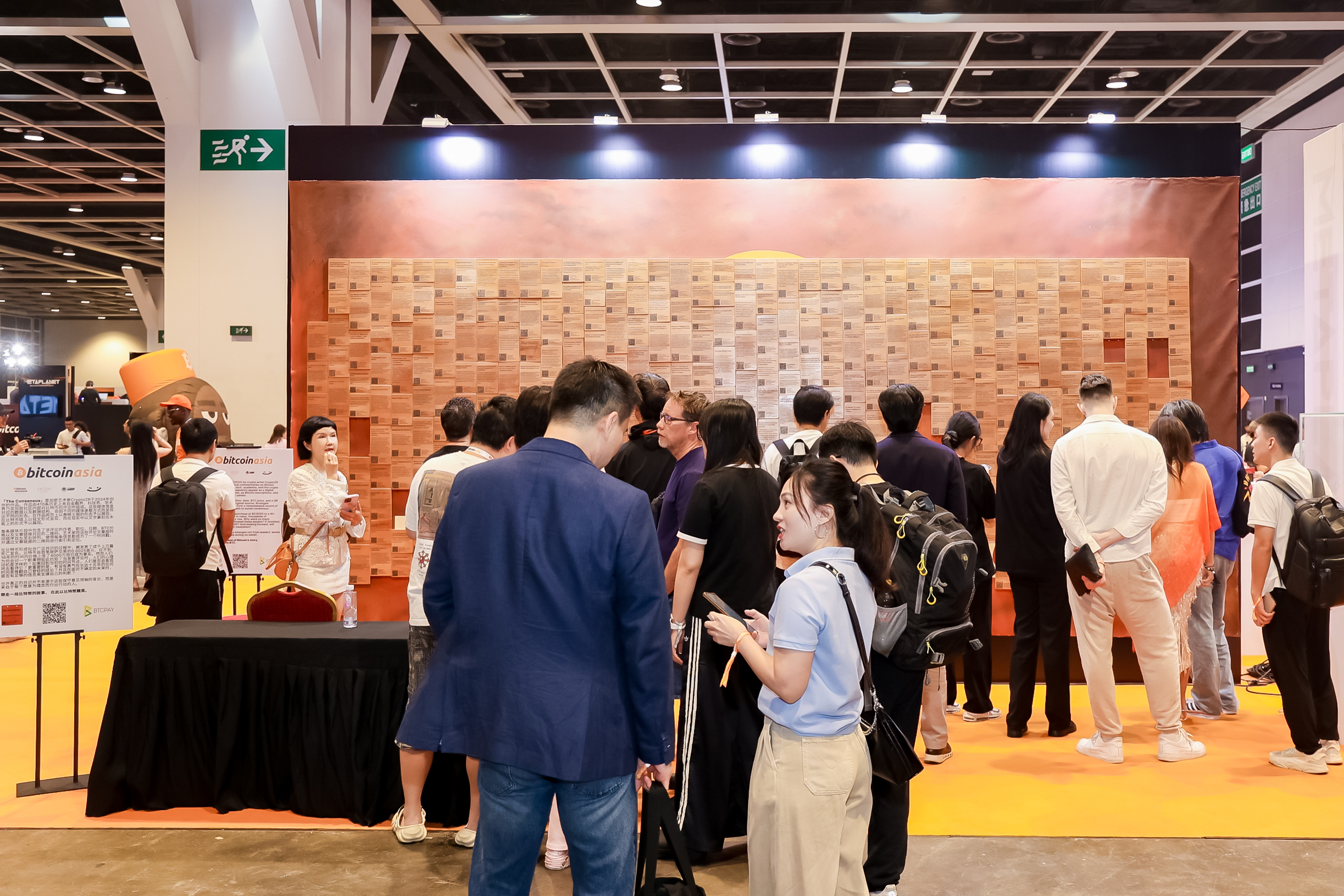
Audience engaging with The Consensus. Image courtesy of Bitcoin Asia
“The Consensus” will be released in ten editions. Most of them will be available for purchasing at the Bitcoin Conferences. Each edition comprises both the engraved panels and the Bitcoin inscriptions, which store the complete commentary texts. These inscriptions can be traded on Bidder.Art (a platform developed by our team) or other inscription marketplaces. The first edition has already been acquired by a significant collector in the contemporary art field, and we are presenting the second edition at Bitcoin Asia. Looking forward to sharing the ideas behind the work with you in person then.